Saturday, August 31, 2013

Balloon Theme for the ELL

 This ballon theme can go along with the birthday resources from my other blog posts, look it up under the label birthday.
 Get the flashcards, class book and memory game at my Teachers pay Teachers Store all in black and White and colored versión.
Counting flashcards:

Flashcards use: 
1.      Hold up the Number Flashcard one by one and have the children identify the number in the balloon.
Teacher: What number is in the balloon ?
            Students: (four).
           Teacher: What color is the balloon ?
           Students: (Green).


2. Hang the flashcards in your room and have students point to the number you say.
Teacher: Point to balloon number 6.
Students: Students point and say the number(six).
Teacher: What color is balloon number 6 ?
Students: (pink)

3. Place all the flashcards on the board or bulletin board. Tell the class that you will say a number and they should say the number in the balloon.
Teacher: Balloon number 2.
Students: Blue.
Teacher: Balloon number 2 is blue.
Students: Balloon number 2 is blue.


 4. You can also do this but naming the color and the students say the color.
 Teacher: Red Balloon.

Students: Three.

Teacher: Balloon number 3 is red.
Students: Balloon number 3 is red.

5. Place all the flashcards on the board. Ask the students their age and have them go to the flashcard and point.
Teacher: Ben, How old are you ?
Ben: Five ( points to the Number 5 flashcard)


 Class Book: Read the book to the class.

Explain that they will be making another book, called class book. All students will be making a page for this book, so make copies of the last two pages. Your students will fill in the sentence starters to tell their names and how many balloons they have. Then, they draw and color as many balloons they wish and color the child as themselves.
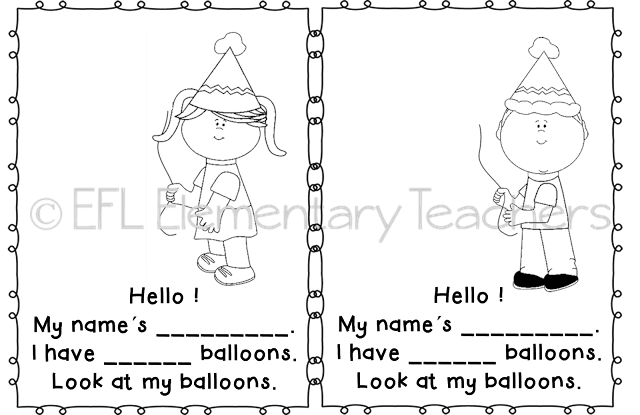


Compile all work into a class book, bind it and read it to the class. Use the front cover of my book to bind your class book. This can be a fun option for your lesson plan. You can also take dictation from your students to complete the pages. By doing this activity in class your students will listen and also respond to oral communication.

I made a black and white version of this book.

     Pointer: I made another pointer.  I made mine out of fun foam. Here´s the template. Get it for free at my Teachers Pay Teachers store.


Memory game: it reinforces learning new vocabulary words in a fun and easy way. It  involves finding pairs of identical balloons when all the cards are face down on the table.I made these cards that be printed onto cardboard, there are two versions, a colored one and a black and white. Use this game  for additional practice.


 Matching game: distribute one card to each student. When you say go, all the students walk around finding their partner in class and stand beside him or her.


Bean bags : they are easy to handle  and can´t roll away when playing in class.Tossing the bean bag helps  develop hand-eye coordination. Integrating this kind  of motor activities into the classroom, will help our students  in attention, and memory facilitating language learning. So, make some bean bags . Mine is made out of felt and filled it up with rice.


Math: use reused bottle caps as counters, start your collection by asking parents for donations. Match water bottle caps to these number flashcards. This activity is great for fine motor and number recognition practice.


 Please leave your comments and follow me!


Monday, August 19, 2013

School Theme for Preschool ESL


Flashcards: As my early beginnings as a teacher, I always used flashcards for drilling vocabulary. I had to make them all, there wasn´t a computer in school back then, so I had to use pictures from magazines or copies from books. Then, when I had my own computer ,I started creating them for my lessons, I had a set for each and every theme. I am sharing a new collection of School Flashcards and some games to play in class as a warm up starting the session or as a wrap up at the end. They are available at my Teachers Pay Teachers store, I have made 175 flashcards.

Link:

Flashcards games:
1.      Place all the flashcards on the table, or board and have the children show each object that you name and repeat the word.
Teacher: Show me a crayon.
Student: crayón.
 You can change the game by saying: Give me  and have the student grab it from the board or table.
2.      If possible make a set of flashcards per table. Name each object and the students line them up on their desks or tables.
Teacher: pencil, glue, bag, eraser.

3.      Pass the objects: Using realia or flashcards start the game in small groups or at their tables.
Student 1: book.
Student 2: thank you
Student 3: book.
Student: thank you.
Have all the students pass the pencil flashcard to the student on his/her right in the group  and name it and say thank you. Continue with all the flashcards.
4.      Step forward: Have a group of students stand in line in front of the class . distribute the cutouts or flashcards.  Name a cutout or flashcard and have the student step forward and show it the class. The class has to repeat the word.
5.  Student Locker: make a locker out of a shoe box and have a student place several cutouts or real school objects in the locker. The student shows the class his/her locker. The class says what he/she has inside, naming all the objects.

Pencil Case craft: You can create your own pencil case and use it instead of flashcards. Have a student name all the objects in the pencil case and slide them up and down. Ask the color of each object.
Write and email and request the free file. (ei98srl@gmail.com)


Sort by color Game: Place colored construction paper or any other kind of colored paper on the floor. I used red, yellow and blue since my cutouts came in those colors. If you are using my cutouts have other colored paper available. Have a group of students sort all the cutouts.


Craft-Third dimension art idea: I printed out two lunch box templates and filled it out with old newspaper, stapled the edges together. It makes a cut decoration for the class.

Game- Match real objects with cutouts. Place all real school objects and cutouts or flashcards in a real school bag. Instruct students to take out the objects and match the real one with the cutout or flashcards. Have students name all the objects.


Follow me!


Wednesday, August 14, 2013

Teaching ESL in the United States


                   I am glad to introduce a new guest blogger who has great advice for teachers.

  My name is Stephen Piotrkowski and I am the Outreach Editor for certificationmap.com, a comprehensive online resource for teacher certification.   Follow me : https://twitter.com/teachercert


How to Transition from Teaching ESL Abroad to Teaching ESL in the United States

English as a second language (ESL) teachers are in high demand all around the world, as more people are looking to learn English. With immigration rates climbing in the United States, ESL teachers are being heavily sought after.

Differences between Teaching Abroad and in the United States

Teaching English in the United States and teaching English as a second language abroad require different qualifications and provide different experiences.

One of the primary differences is teaching English in the United States requires a bachelor’s or master’s degree in combination with both teacher certification and ESL certification. Those who wish to teach English abroad do not typically need a teaching degree but will require TESOL certification. This makes obtaining a job teaching English abroad much easier than finding one within the United States.

Some individuals mistakenly assume English is the same, regardless of where you go, but the English language has several variances, with British and American English being the most popular. When teaching ESL in the United States, American English is the only one teachers must know.

Other countries, though, frequently express a preference for British English, requiring teachers to be familiar with this variation. In many cases, it is useful to know both British and American variations.


Making the Transition

One of the challenging aspects of teaching in a new country is making the transition from living abroad and coming to the United States. Many teachers serving abroad must leave behind the cultural differences they have grown accustomed to.  

Many teachers who teach abroad come to the United States to resume typical teaching jobs or use their TESOL certification to teach English to non-native speakers in the United States. Others come to the United States to attend school to obtain a master’s degree or work with nonprofit organizations. It is important to determine if you will need to complete additional coursework to begin working in the United States.

Those who are coming from abroad and plan to become an ESL teacher in the United States must obtain the proper bachelor’s degree in the education field, teaching certification and ESL certification to qualify as a U.S. ESL teacher.

Here is a quick look at each of the 50 states’ teacher certification requirements. 

Links:


Friday, August 9, 2013

Circus Theme for ELL

This is part 1 for the Circus Unit resource. Part 2 can be found here:
The link is to my Teachers Pay Teachers store: 
or this store:

1.  Pocket charts: searching other teacher´s blog I saw how they use them in their classes and thought about incorporating them in my EFL class. I bought one, it is very small, but we usually get small classrooms or either we share with another teacher the space. The good thing is that if you rotate through school you can carry it with you because it folds and it´s not heavy at all. You can make pocket charts for teaching vocabulary, and for discipline matters. Store all your pocket charts resources by theme in ziplock bags and label for further use. I usually print everything on cardboard and if possible laminate. 
Remember to use a pointer when reading the circus vocabulary with the pocket chart.
circus vocabulary pocket chart.

I found this clown´s head and feet that matches the theme.  I can send it to your email. Please write a request: ei98srl@gmail.com

2.  Puppets: use them for oral drill of any structure that you teaching in class, for reviewing vocabulary words, for greeting the students or for motivating them. You can make your set or have students make their own puppets.  I got the printable from the internet search. I do have the file, it is only by email request.(ei98srl@gmail.com)
I also made some movable puppets which I printed onto cardboard, cut out all the pieces, made holes using a hole puncher, used tiny brads to join all the pieces. They also make an excellent resource to teach the body parts. Once again, it is yours by email request.

3.  Circus assemble: my book Jellybeans (RichmondPublishing) has a nice idea for making this kind of diorama for the circus theme. I used a paper plate as instructed, but a shoe box will work as well. I added the tent top as background. The students can classify the people and the animals that work at the circus using the circus assemble.  Ask for it. (ei98srl@gmail.com)

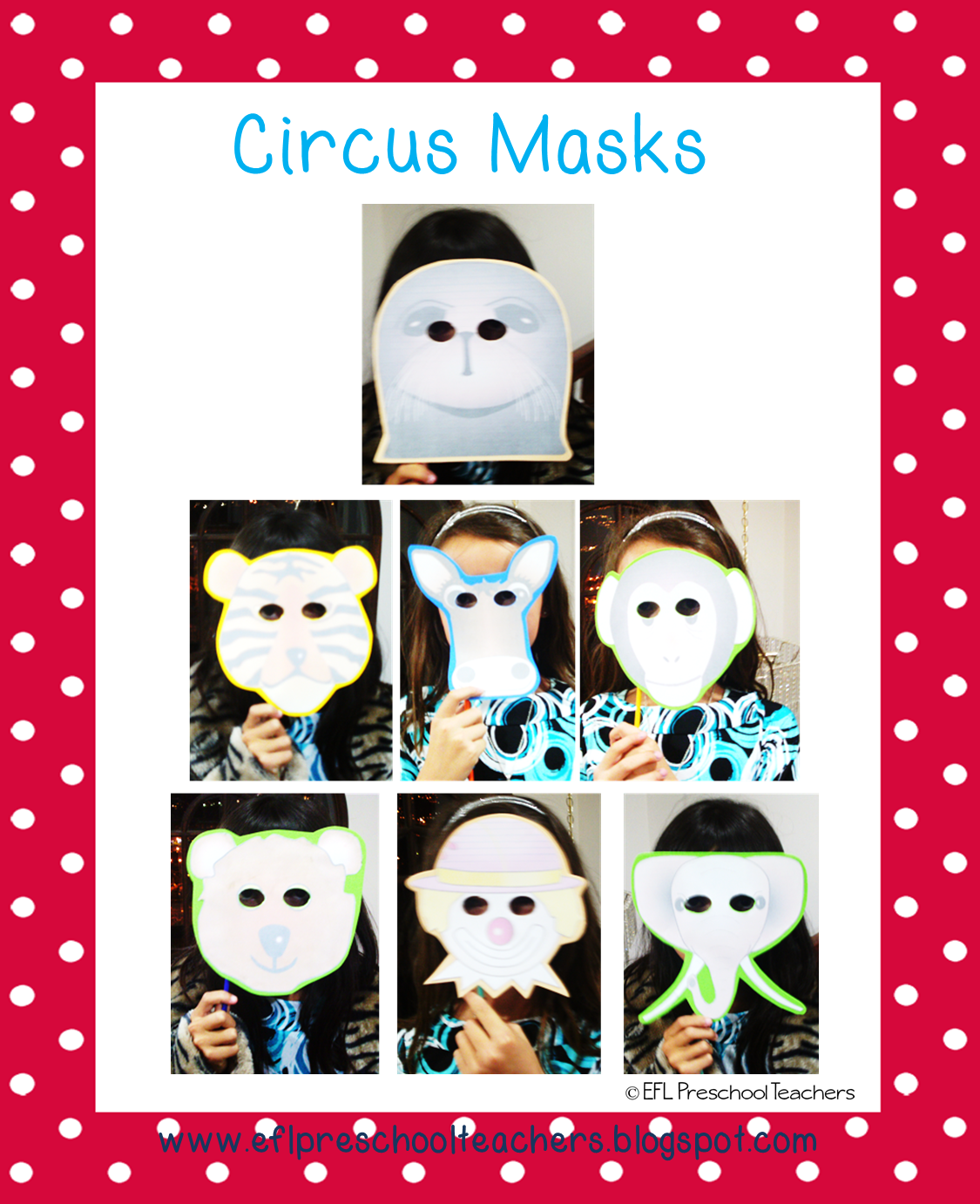
4.  Circus Role Play Masks: I got these lovely print at this great website and for free.  
http://www.sparklebox.co.uk/1691-1695/sb1693.html#.UgT8Ufi35ok

5.  Cut and paste: Searching the web I found this clown and thought about a shape and face review activity. This is an art technique that is appropiate for the EFL class. Use all kinds of materials such as different colored and textured  papers,beads, glitter, feathers. Just plan on using the best glue and scissors for your class, by asking the room teacher.Get it from me.

6.  Ringmaster props: I saw this nice idea at my Jellybeans book. Play the Ringmaster Says instead of  Simon Says.  I made my props out of fun foam which is my favorite material for creating my props that can double as photo props or you can use them for playing the Ringmaster Teacher as you greet them at the door. 

7. Circus Book: There aren´t many books for the EFL class that are adapted for our needs , so I´m making my own. I came up with this book. It can be printed in black and white or full color. Reading the book to the class exposes them to the vocabulary in a context, with engaging colored images which review all the words and structures. Have them around so the students can read by themselves.
Print the book and make it a coloring book.
8. Review the alphabet with the Letter Arts and Crafts.


Follow me!