Showing posts with label graphing. Show all posts

Monday, May 3, 2021

Pets unit Flashcards for Kindergarten English Language Learners

  Get the complete Pets Unit for Kindergarten ELLs with flashcards, small cards, cutouts, worksheets, games, printable books, and more ready-to-use activities to make your lessons engaging and effective. LINK to the resource:   https://www.teacherspayteachers.com/Product/Pets-Unit-for-Kindergarten-Holistic-English-Series-16-6837926

Pets Unit Flashcards and activities Resource

These Pets Flashcards for Kindergarten ESL help students learn and use vocabulary such as dog, cat, fish, bird, rabbit, and hamster through speaking, sorting, and hands-on activities.
Pets Vocabulary Introduction

Use the Animals Pets unit Flashcards to identify and describe the pets using the verb to be. Students will learn the pets vocabulary.

Place the pets flashcards in random order one on top of the other on the board and have the students guess the animal. 
Teacher: What’s this?
Students: cat!

Teacher: What color is the cat?
Students: black and white.
Teacher: It's a black and white cat.

pets flashcards printable

Place all the flashcards on the board and have the students name them all using a pointer.

Sorting and Categorizing Pets

Students can sort all the same animals under each column. Learning and thinking comes as they find similarities and differences between the animals.
 Also use them to have the students say the animal sounds.
Model some sentences: The bird is blue. The bird isn´t green.

pets flashcards Kindergarten ESOL

Play Show me!

Sorting the Pets by color

Place the color flashcards on the board and have the students sort all the pets into colors. Sorting helps with attention and memory. When it is done, ask questions.

Teacher: Which pets are blue?
Students: fish! Bird!
Teacher: What color is the fish?
Students: purple!

sorting pets flashcards by color and category kindergarten

Ask yes/no questions!


Counting and Numbers Practice with the pets flashcards

A little counting. Students need to experience numbers in different ways. Use the see flashcard to get the meaning across of the structure: How many (pets) do you see?

Place the flashcards in random number order on the board. Have them count with you and write the number of pets that on the flashcard.
Teacher: (Show the see flashcard or point to it on the board)
How many fish can you see?
Students: one, two, three, four! Four fish!
Use these flashcards to review the structure: What are these?


counting pets flashcards ESL numbers activity

Big and small pets Practice

 Learning and using adjectives will make their sentences more meaningful as they can describe the pet's size.

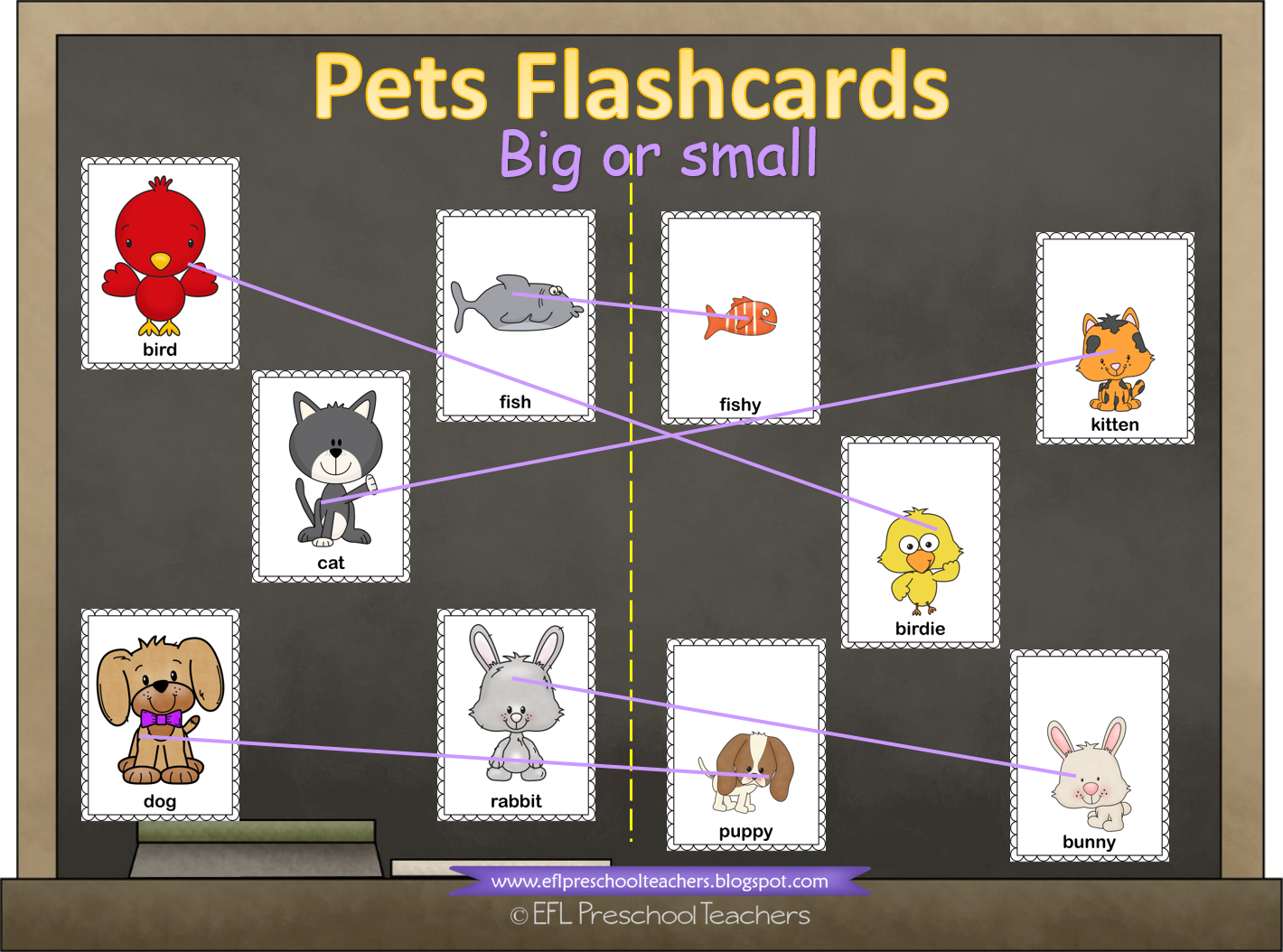
I used the words on the flashcards for the baby animals as I see on most text books. I can do any other word if needed. Divide the board in two sections. Write the words big and small. Review with your students the words. Tell them to place the flashcards on the section that they belong.

Then, use a marker or chalk and trace a line from the big bird to the birdie. Students can help you with this.

Use these flashcards to do the mommy-baby relationship with fishy,kitten,bunny,birdie,puppy. Students will associate the baby pets with their mothers.Some will say cats and baby cats.
pets flashcards ESL classroom activity small big

Likes and Dislikes Activities

Show the students the like flashcard and the don’t like flashcard. Have them imitate the faces for each one. Place these flashcards on the board. Have the students pick a pet that they like and one that they don’t like and place them on the corresponding part of the board.  
Teacher: Do you like birds?
Student: Yes, I do.
Ask questions with do as they place their cards. This is a way for the students to express their likes and dislikes.

Student: I don't like cats!

pets vocabulary speaking activity English learners

Then graph the results with the class. Show students how to read a graph and ask questions about it.

Graphing and Personalization

Students can express what pet they have. Graph as students talk about their belongings.
Pedro: I have a bird.

pets unit graphing with flashcards

All pets have a name

 Place the pets flashcards on the board and have them give a name to all the pets and write them.
Students: A cat.
Teacher: What’s its name?
Students: Lola.
Teacher: What’s this ?

Ask your students about the name their pets have.

pets flashcards kindergarten ESL

Review the shapes with the pets flashcards

 Have the students differentiate the pets. Students will separate the pets based on their similarities.
Draw the 4 shapes on the board and divide into sections.
Hand in the pets and have the students sort the pets on the board according to its shape.
When all the pets are placed ask questions.
Teacher: What shape is this?
Students: rectangle!
Teacher: Let’s name the animals here. ( point as the students name them)
Students: rabbit, cat, frog, fish, turtle, bird, mouse, dog.

Review the shapes with the pets flashcards

Introduce the grammar point: I want and - or He/She wants.

Place all the flashcards on the board.  Introduce the first flashcard: Wendy (pointing to the girl) wants a bird (point to the bird)
Continue with the help of the class with all the other children. You can also ask questions.
Teacher: What pet does Kay want?
Students: a fish!

Teacher: Kay wants a fish!

Teach students how to express their own wants.
Teacher: What do you want?

I want and - or He/She wants with pets flashcards

Have  for the simple present

Choose several students to come to the front. Hand in a flashcard to each one and show it to the class. Have them take one step forward and say the sentence that have modeled.
Student: I have a hamster.
Ask questions:
Teacher: Who has a fish?
Students: Mary!
Teacher: What does Billy have?
Students: a cat!

pets flashcards ESL classroom activity

                              Use the flashcards as well. Ask questions:
Teacher: Do you have a cat?
Student: Yes, I do.
Use the possessive pronoun: my.
Student: This is my fish!

pets flashcards ESL classroom activity

 family members also have pets

Students can bring a picture of their pets and you can do this activity using those instead of the flashcards. You can also make a graph asking the same question.
 Ask about how the family members take care of pets.


 Place a family member flashcard along with a pet flashcard on the board. Model a sentence.
                               Teacher: Grandma has a rabbit.

Students: Grandpa has a cat.
Ask questions:
Teacher: What pet does Mom have?
Students: A dog.
Name a pet and students say the family member that has it.
Teacher: frog!
Students: Dad!
Say the family member and the students name the pet that person has.
Teacher: Brother!
Students: Iguana!

family members also have pets

pets move flashcards

Use the flashcards: fly,swim,jump,walk,eat They will identify the animal movements.

   Have them share what they know on how their pets move and perform the action. Place one by one the action flashcards on the board. Say the action and have your students do the action.
Teacher: What is this?
Students: a bird!
Teacher: How does the bird move? It flys!! ( perform the fly action)
Students: fly ! fly! Fly! (have the students perform and say the word three times).
You can also use the TPR action as Flap like a bird or swim like a turtle.

Add some sentences using can. 
Teacher: The fish can swim!!

Students will be able to identify how the pets move.
Teacher: Can a cat walk?
Students: Yes, it can.
Teacher: Can a dog fly?
Students: No, it can't.

basic classroom commands in English

Pets flashcards can work for Command

There is another one. Wash!

Bring in some plastic dogs into the class, add some dirt on it and have the students to actually wash it.

class room commands

 pets have a place as a home or a habitat

They should be able to associatepets with their homes. Explain about the characteristics of each one.
Place the pets flashcards on the board and then one by one the pets home.
Teacher: What’s this?
Students: a hamster.
Teacher: This is the hamster’s home. A hamster cage.
Students: A hamster cage.
Continue with the all the pets.
Teacher: What home is this? A rabbit’s.

Teacher: Where does the rabbit live?
Students: In a rabbit cage.

pets have a place as a home or a habitat

Pets eat flashcards 

 Students will identify, classify and describe the food  or drinks for eachpet. 

I did a little research on what pets eat. I will leave a note on that here.
Place a pet on the board and have the students guess what they eat as you have all the food flashcards on the board ledge for the students to see.
Teacher: This is a turtle. What does it eat?
Students: tomato!
Teacher: YES!
Students: milk!
Teacher: NO!
Place the correct ones next to the pet. Continue with all the other ones.


Pets eat food flashcards activity

The pets have emotions 

Have the students sort the animals according to the emotion. Then, say a pet’s emotions and have a student come and take it off the board.
Teacher: Gina, a sad dog!


The pets have emotions flashcards

The pets have a body 

Place any flashcard on the board and with your students have them name the body parts that they know and introduce the new body parts that belong to that pet. I made my example with the bird.The body parts would include: tail, paw, fin, wing.

Ask questions. How many legs does the bird have?
                      Students: two.

The pets have a body flashcards

The pets make sounds 
Students can describe the pets on the flashcards and talk about what sounds animals make. Place several flashcards on the board and see what sounds do the students know.

Pets sounds in English

Review the numbers using the frog numbers flashcards.

Teacher: What number is this?
Students: five!
These flashcards can be used to place them in order on the board.

Review the numbers using the frog numbers flashcards.

More things are included in this resource, go to the blog post:https://eflpreschoolteachers.blogspot.com/2024/09/counting-halloween-cats-in-haunted-house.html 

pets flashcards kindergarten ESL

Thursday, April 1, 2021

Food Unit Flashcards for Kindergarten English Language Learners

      Get the Complete Food Unit Resource.Save time and have everything ready for your lessons.  LINK to the Educational Material for your English lessons: https://www.teacherspayteachers.com/Product/Food-Unit-for-Kindergarten-Holistic-English-Series-15-6741090

Food unit resource

These Food Flashcards for Kindergarten ESL are designed to help students learn and recognize essential food vocabulary such as apple, banana, bread, milk, and juice through clear and engaging visuals.   This resource is not meant to be used alone—it is the first step in a complete food unit, helping students move from vocabulary recognition to real language use.

INTRODUCING FOOD VOCABULARY

Use the flashcards to introduce common food words. This is the stage where students connect words with meaning through visuals.

Teacher: This is milk.
Students:milk!

food flashcards kindergarten ESL apple banana bread milk vocabulary

Introduce students to It is and They are.

Teacher: It’s a cookie.
They are carrots.
You can also review this/these.

Teacher: This is a hot dog . These are french fries.
Also ask questions: What do you want?
food vocabulary kindergarten ESL fruits drinks basic words

Students can answer the question How many? as they count the food items.
Teacher: Look at the eggs. How many eggs?
Students: one, two, three, four. Four eggs
.

ESL speaking activity food flashcards kindergarten students

Ask students about their favorite food and /or drinks. 

Make a graph using the flashcards.

food flashcard activity kindergarten ESL vocabulary practice

Expressing and Respecting Opinions.What food do you like? 

Place the emoji like/don´t like Flashcards on each side of the board to introduce the verb like. Have the students go through the food flashcards and place them on the side of the board of their likes. Example sentences to model for the students for expressing likes and dislikes.
Teacher: I like hot chocolate.
I don't like peas.
Teacher: Do you like ice cream?
Yes, I do.

Ask questions:
Teacher: Do you like hamburgers?
Students: YES!

Expressing and Respecting Opinions.What food do you like?


Use this other set of flashcards. Tell them that each child has food that they like.
Teacher: Look at Emily! She likes cupcakes.
Students can make sentences with the flashcards.

Teacher: Who has a lemonade?
Students: Mark!

Talk about ongoing actions.
Teacher: Dick is eating an ice cream.

food unit ESL kindergarten vocabulary learning activity

Use the flashcards to play a game.
Say a name and have the students say what the person has.
Teacher: Andy!
Students: French fries!
The same flashcards can be used to make sentences with HAS.
Teacher: Look at Nancy! She has a hamburger.
Teacher: Look at Mark! What does he have?
Students: a lemonade.

English lessons food unit flashcards

Sorting the FOOD VOCABULARY

Sort the food flashcards into food, drink and dessert. 
Teacher: Steak is food. Soda is a drink.
Student: Here.
Teacher: Thank you!
Student: You're welcome.
Have your students hand in the food flashcards using functional language as they respond appropriately.
Teacher: Give me the pizza, please!

Food sorting flashcards Ingles

What's there in the lunchbox

 Place the flashcard of the lunchbox in the middle of the boad. Ask students what they had in their lunchbox. Place those flashcards as in a mind map. Here is my example.
Teacher: This is my lunch box.  There's a sandwich, a chocolate, a juice and yogurt.

Lunchbox flashcard ESL

Review emotions with the food flashcards

The teacher will show an emotion flashcard to the class have them mime the feeling. Teacher: This is an angry pizza!

Review emotions with the food flashcards

Show a flashcard.
Students: a hot dog!
Teacher: Is the hot dog happy?
Students: Yes!

Place the hot dog under the happy word.Continue with all the flashcards.

Food vocabulary flashcards

What about reviewing the shapes

Show each pizza shape flashcard and have the students place the flashcard under each word.
Teacher: What shape is this?
Students: circle!

Food Flashcards for Kindergarten ESL

Then, have the students sort the food items according to the shape.
Teacher: What is this?
Students: pizza!
Teacher: What shape is the pizza?
Students: triangle!

sort the food items according to the shape.

Review the parts of the face with the FOOD flashcards

There is a set of flashcards with food that have facial features to review that vocabulary.The teacher will hold any flashcard and say: Look! The eyes.Show me your eyes.
 
Review the parts of the face with the FOOD flashcards

Place a flashcard in the middle of the board. have the students name and show the parts of the face: eyes! nose! Ask what's missing? Students will say that the nose and ears and draw them.
There are also a set of worksheets to do the same.

Food unit and the face review hamburger

Review the colors with the ice cream flashcards

Just ice cream flashcards in different colors to review. Ask questions:
What color is this ice cream?
Students: yellow!
Teacher: Joe, find the purple ice cream! Give it to me.

Review the colors with the ice cream flashcards

Review the numbers 1 to 10 with the ice cream flashcards

Place the ice cream quantities flashcards on the board in random order. Have the students come up and count the scoops of ice cream and write the number next to the flashcard. (There is a worksheet for extra practice)

Seasons: Summer

Review the colors with the lemonade flashcards

Do the same with the lemonade flashcards. 
Teacher: What color is this lemonade?
Students: green!
Teacher: Show me a red lemonade!

lemonade flashcards

Review the school objects with the cookies flashcards

Concentrate on just cookies if you want. Here is a set of flashcards. Students should be able to identify and name the classroom items that each cookie has.
Ask questions: Is this cookie a boy or a girl?
Students: a boy!
Teacher: What does the girl have in her hand?
Students: a book!
There is a worksheet to work along.

identify and name the classroom items

Commands Flashcards (Imperatives)
 Use the cards to give a command and have the students follow the order. Also, have the students give orders to the class to follow. The commands help with social skills to interact with the teacher and other students.
Teacher: Eat your sandwich!
 Also introduce: I'm hungry! 

english commands in the classroom

Use the commands Flashcards to have the students mime actions.
                    Teacher: Find a food cutout and eat!

commands Flashcards

Food Unit Crafts, Rewards & Classroom Ideas for Kindergarten ELL are here, go to the blog post:   https://eflpreschoolteachers.blogspot.com/2021/04/food-unit-crafts-rewards-and-more-for.html