Showing posts with label size. Show all posts

Wednesday, September 14, 2022

Beach Unit Worksheets for Kindergarten ESL

 Get the Beach Unit resource for Teaching Kindergarten English Language Learners or Special ED here!! https://www.teacherspayteachers.com/Product/Beach-Unit-for-Kindergarten-Holistic-English-Series-30-8461749

Enseigner l'anglais

These Beach Unit worksheets are designed to help young English Language Learners (ESL) practice and reinforce vocabulary through hands-on, creative, and structured activities. From tracing and matching to coloring and cutting, students engage with language while developing fine motor and early literacy skills.

Printable Beach Unit Worksheets to practice and review the new concepts, the vocabulary items. Simple easy exercises to complete.

Tracing & Vocabulary Cards

This is the vocabulary set of worksheets that can turn into your student’s flashcards. The early literacy skill would be tracing over the beach words.If you cut them in two students can do a matching activity on their table or on the pocket chart.Give students simple instructions as to take care of the pocket chart and how to use it.

Ejercicios de ingles

Beach Worksheet Coloring & Creativity

 Beach day Worksheets are still a learning tool for teaching Presachool and kindergarten. This worksheet is for and coloring decorating as the student’s creativity is up to.  Then, they can cut them and display around the classroom for a Beach feeling.

beach coloring worksheet ESL kindergarten

What about the swimwear for the beach? There is a set of worksheets for the swimwear for boy and girl as a clothes theme activity.

swimwear for the beach worksheets

Students will decorate their swimsuit as they wish, giving a personal touch to this worksheet.

kindergarten ESL coloring activity summer

Students can cut their swimwear and hang it up on a  clothesline in the classroom as decoration.

beach unit worksheets English learners

Matching Activities with numbers 1 to 10

The worksheets are easy for the parents to guide their kid to completing them. Use these to consolidate main numeracy skills in English. Students will identify the numbers 1 to 10. Just matching the numbers to the quantities in each set. You can also choose magnetic numbers. Use questions words: How MANY?
Teacher: How many crabs are here?
Students: six!

matching the numbers beach worksheets

Many things to do with these worksheets. Students can cut the crab sets and the numbers and play a matching game with their peers.

kindergarten ESL beach theme worksheets

Have your learners describe each match, take a look!

Students can also place the numbers in a numerical sequence on the board or on the table.

beach worksheets for kindergarten

You can write the number words on small cards for the students to add to each numerical item.

Beach day Worksheets numbers 1 to 10

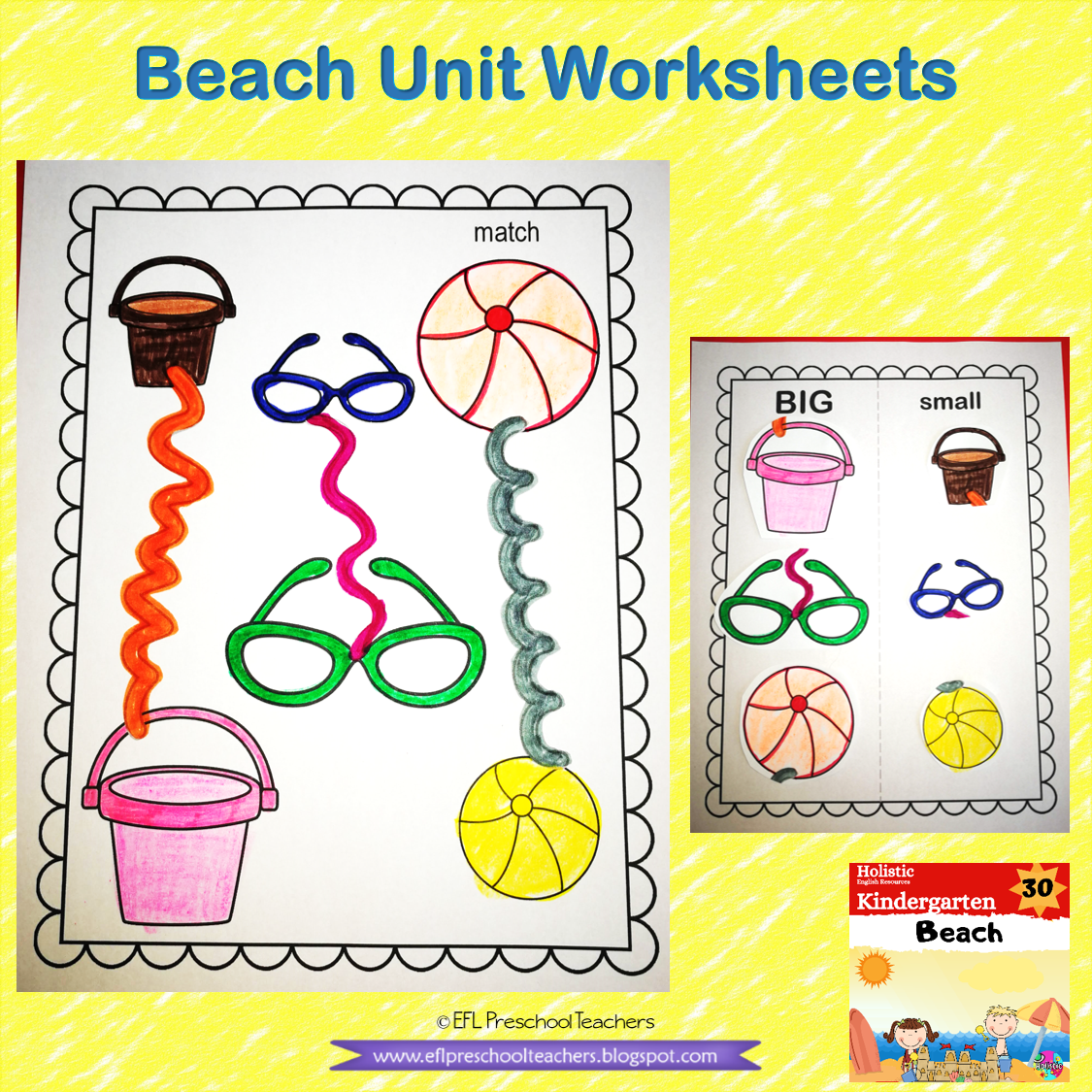
Students will identify the size. Review the concept of Big and small beach items with this set of worksheets. Have them follow directions as they  complete the worksheet coloring the big and small bucket, sunglasses and ball, besides coloring the path lines. Then, they cut all the items and sort them on the other worksheet.

Big and small beach items  worksheets

Effective literacy skills are importante to establish in an English learning environment. As with the presentation of the Beach Flashcards, we  sorted them into nature and things, here is a set of worksheets to reinforce the concept.
sorting into nature and things Beach  items

cut and paste worksheets

Students will color the items and then cut and paste them where they belong. THis is a sorting into the category of nature and things.

vocabulary matching beach theme worksheet

Here is the activity done.
beach coloring worksheet ESL kindergarten

Worksheets to draw, trace, color and more.
Ask questions: What is the frog doing?
Students: It's surfing!
Do the listen and color activity with the worksheets.
kindergarten ESL beach theme worksheets

There is a beach scene worksheets for the students to draw themselves at the beach and what think that michgt see when they go there. They can also glue a picture of them at the beach.

This beach ESL activity with buckets and shovels is perfect for teaching colors and vocabulary to kindergarten students through hands-on learning, go to the blog post:   https://eflpreschoolteachers.blogspot.com/2025/05/beach-fun-with-buckets-and-shovels.html 


Find me on Instagram:   https://www.instagram.com/rosamelia_eslteacher

ingles para niños


Saturday, August 13, 2022

Sea Unit Worksheets for the Kindergarten EFL

 This complete Sea Unit for kindergarten English language learners includes printable flashcards, worksheets, games, small cards, cutouts, speaking activities, vocabulary practice, printable books, crafts, and hands-on ESL resources designed especially for preschool and kindergarten students. LINK: https://www.teacherspayteachers.com/Product/Sea-Unit-for-Kindergarten-Holistic-English-Series-29-8348964

Preschool activities

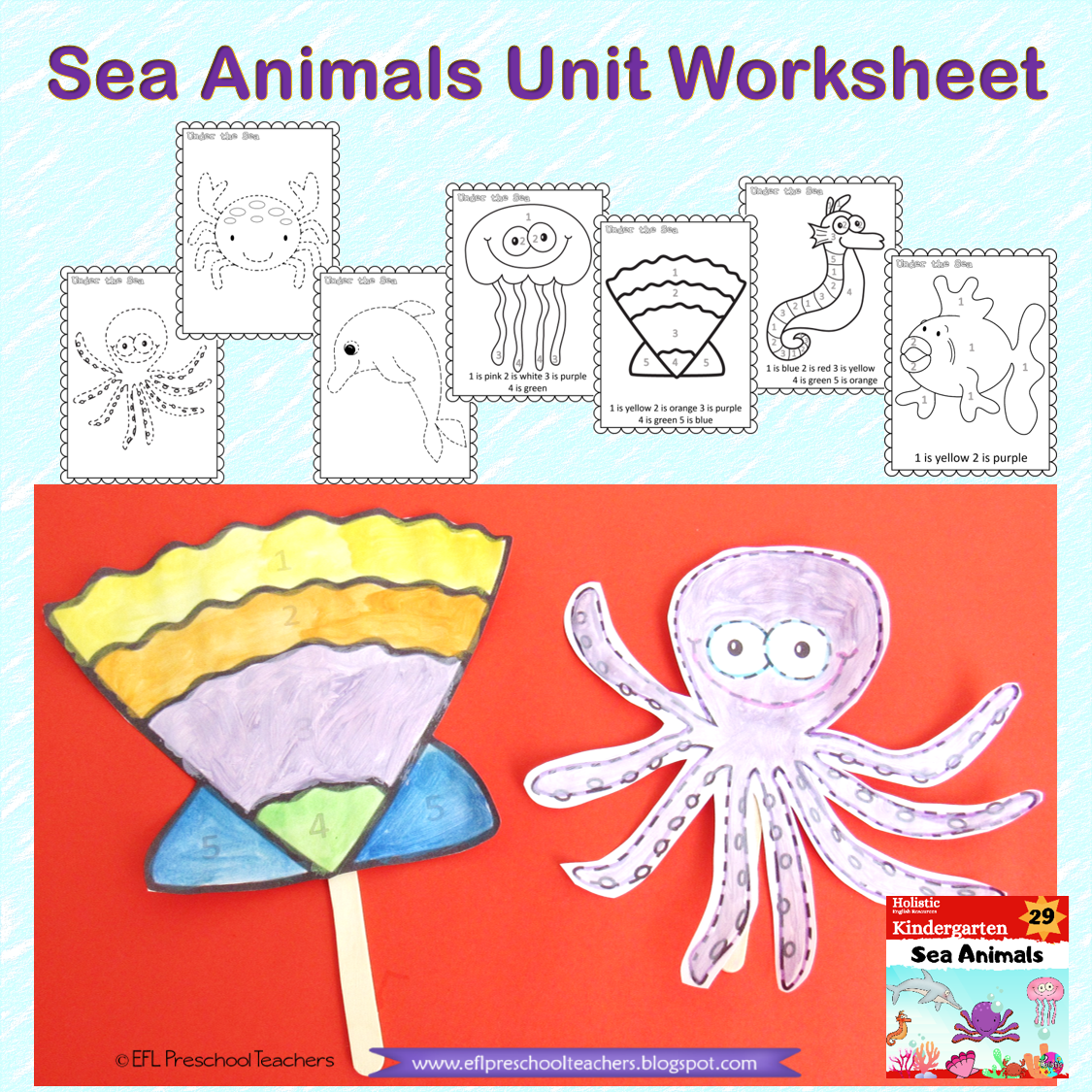
Practice sea animals vocabulary with these engaging Sea Animals Worksheets for preschool and kindergarten English language learners. The activities include vocabulary recognition, emotions sorting, counting practice, tracing, coloring, listening tasks, visual discrimination, and speaking opportunities designed to help young ESL and EFL students build vocabulary confidence and communication skills.

These printable sea animals worksheets are perfect for literacy centers, vocabulary review, independent practice, assessment activities, fine motor development, and hands-on learning for preschool and kindergarten English learners.


Sea Unit Worksheets are optional for your lesson plan, not a I have to do this. It’s just a review. Perfect for reinforcement of the new grammar and vocabulary in the unit. Most of these activities for after the worksheet is completed will appeal to the different learning styles present in your classroom.

Sea Animals Vocabulary and Listening Activities

Just let our children play even more with worksheets. This is the vocabulary set of cards. Students will be able to folow simple directions such as coloring. 
Teacher: Color the crab red!

Many games can be played with them as a practice of the motor skills. It is a listening activity to recycle the vocabulary from the unit. I used them for the simple bowling game using plastic soda bottles.
 Ask questions: What do you see?
Students: I see a seahorse.

Actividades niños - aprendiendo ingles

Fine Motor and Vocabulary Practice

Fine motor skills practice is a must at this age. Simple tracing or coloring worksheets that can be turned into craft stick puppets to use for other activities in class. Tracing is a fine activity for the learning to learn competence.
Ideas nido

Sea Animals Emotions Sorting Activities

Focus and visual discrimination can be mastered through the use of simple worksheets. It is a pre-reading and a pre-writing skill to develop.

This is a set of kindergarten emotions sorting worksheets for the students to identify and express the feelings.  Students recognize and talk about feelings while practicing ocean vocabulary. After cutting out the sea creature pictures, children sort them onto the happy, sad, and angry mats according to each character's facial expression. As students complete the activity, encourage them to describe their choices by saying sentences such as "The crab is happy," or "The jellyfish is sad." 

Make the worksheet more interactive. Students can color the sea creature worksheet, cut out the individual pictures. The sea creatures can be sorted on a table or displayed in a pocket chart, giving teachers flexible options for small-groups activities. Children can classify the cards by emotions by deciding whether each sea creature looks happy, sad, or angry, or they can sort them by type of sea creature, grouping together crabs, jellyfish, octopuses, starfish, shells, and other ocean animals

Students will use the verb to be in sentences: The pink jellyfish is sad.

Ask questions: Is the yellow starfish happy or sad?
Students: sad!

Use the worksheets for a quick assessment to check if your students recognize the feelings: happy, sad and angry. Students just color the sea creatures by themselves. Then, they can cut each item and play by putting them the magic box as they name each one.

Student: a red crab!

sea animals emotions sorting worksheet for preschool ESL

Have the students review how to describe the feelings by using this worksheet. I made a set of cups with the emotions words and also another set with the sea creature word.

Students put the cup of the emotion on each item. They can even make a simple sentence: The octopus is sad.

recursos lúdicos inglês

Practice Big and Small with Sea Animals

Send a worksheet home for the parents to do with the kids once in a while for them to see their progress. This adjectives big and small sorting the sea creatures one would be nice.

Early elementary resources

Sea Animals Numbers and Counting Activities

A set of worksheets to match numerals 1 to 10 to sets of jellyfishes. Students can also color the numbers as you dictate: Number five is green.

Student: This is number two. It's black.

Education Sea Animals Numbers Worksheets

Sea Animals also eat! 
Here is a set of worksheet where students draw what the that animal is eating. Activate their imagination with real or unreal food that those animals eat.


Ocean Scene Vocabulary Activity
Use the sea scene worksheet to do a little drawing and if you can do a little writing.
Place the worksheet into a clear plastic sheet and have the stduenst draw the sea animal on the sea using a white board marker that can be easily wipped off and reuse again. Students an use teh small cards as a guide to the drawing.

sea creature worksheets ESOL

The good thing about using small cards or flashcards is that students get to write the word and draw.

sea creature trace worksheets

Some students would love to trace the sea creature and the word.

sea creature worksheets

These shark and crayons activities are perfect for preschool ESL, kindergarten EFL, literacy centers, speaking practice, color recognition, ocean themes, school supplies review, and hands-on learning for young English learners, go to the blog post:   https://eflpreschoolteachers.blogspot.com/2025/06/sharks-with-crayons-for-kindergarten.html 


I would like to share my Instagram account. Please visit the account:   https://www.instagram.com/rosamelia_eslteacher

Wednesday, August 10, 2022

Sea Unit Cutouts for Kindergarten ESOL

 This complete Sea Unit for kindergarten English language learners includes printable flashcards, worksheets, games, small cards, cutouts, speaking activities, vocabulary practice, printable books, crafts, and hands-on ESL resources designed especially for preschool and kindergarten students.LINK:                 https://www.teacherspayteachers.com/Product/Sea-Unit-for-Kindergarten-Holistic-English-Series-29-8348964

Material clases

Practice sea animals vocabulary through hands-on learning with these Sea Animals Cutouts for preschool and kindergarten English language learners. The printable cutouts include colorful ocean creatures such as fish, sharks, dolphins, octopuses, crabs, turtles, jellyfish, seahorses, and shells to help young ESL and EFL students develop vocabulary recognition, speaking skills, sorting abilities, prepositions practice, and sentence-building confidence.

These sea animals cutouts are perfect for dramatic play, literacy centers, speaking activities, ocean theme lessons, sorting games, vocabulary review, and interactive classroom learning for preschool and kindergarten English learners.


Sea Animals Vocabulary color sorting activity

Sea Animals Cutouts help you create easy and dynamic classes. 

 Simply place the ocean animal cutouts on the table and invite students to match each one with the correct colored splotch. The splotches act as visual sorting guides, helping young learners identify and classify colors while reviewing ocean animal vocabulary. 

As students complete the activity, encourage them to say the color and the animal aloud, such as "Blue fish," "Purple octopus," or "Gray shark." This hands-on game strengthens color recognition, speaking, and vocabulary development while building critical thinking and classification skills. It is an easy-to-prepare activity that is perfect for learning centers, small groups, independent practice, and preschool, kindergarten, ESL, and EFL classrooms.

This is a problem solving activity. I used the word for the colors cutouts from unit 2 to match the word to the sea creature cutout.

sea animals cutouts for kindergarten ESL students”

Practice Big and Small with Sea Animals

I used two lunch bags to create a feed me box for the big sea creatures and two more for the small ones.      I did a little decoration using crepe paper. Ready to sort the cutouts into big and small. This makes learning meaningful and fun.

feed me box big and small

Students can sort the cutouts by type of sea creature. This is an essential skill to build in Kindergarten.

Teacher: Find all the fish and put them here!

sea animals classification activity for kindergarten ELLs

Create an Interactive Ocean Scene

I love creating scenes. They work as a communicative activity to add to your lesson plan.Students at this age usually develop at their pace and get involved in the activities that they find interesting. 

 I used a box and wrapped it up with blue paper and added some construction here and there. I hanged some sea animals using thread. I opened some clips and taped them behind several animals to make them stand. Other animals were just tapped around the box. Hope you make yours and show it to me.

Ask questions:
Teacher:How many shells are there?
Students: one, two, three,four, five. There are five shells

Teacher: Are there any dolphins?
Students: Yes, there are.

Teacher: Where is the octopus?
Students:It is next to the clam.

Students can describe the sea animals using prepositions.
The sea turtle is next to the shell.

Ask about the abilities and inabilities of the sea creatures.
Teacher: Can a dolphin swim?
Students: yes, it can.

interactive ocean scene activity for preschool English learners

Masks are important for people at the sea. Print the cutout and add cellophane paper behind the printable and a craft stick. Have them look around the sea scene with their goggles and say what they can see.

Students: I can see a dolphin!

Englischunterricht

Sea Unit Feed me box

Use it to promote social interaction as a communication strategy. Make learning enjoyable.

There are several more sea creatures to make the feed me box. I chose the fish. You can have children feed it anything. Use the cutouts or have them draw what they want to feed the fish.

fish feed me box vocabulary activity for kindergarten English learners”


Sea Animals Flashcards for Kindergarten English Learners, go to the Blog post here:

Do you love Pinterest? I do, find me there, save pins and follow any of my boards.LINK: https://www.pinterest.com/ei98srl/

Tuesday, May 17, 2022

Zoo Animals Unit Flashcards for Kindergarten English Language Learners

 Find Zoo Animals activities for kindergarten ESL students including worksheets, games, crafts, counting activities, and printable classroom resources, all here:    https://www.teacherspayteachers.com/Product/Zoo-Animals-Unit-for-Kindergarten-Holistic-English-Series-26-8078353

ZOO or Jungle unit  for Kindergarten English Language Learners

Research has shown that using flashcards in the classroom helps to improve the students’ vocabulary knowledge by using them to play games and speaking activities keeping the students interested.This resource includes colorful flashcards, movement activities, vocabulary practice, body parts review, emotions, shapes, commands, and interactive games designed especially for young ESL and EFL students.


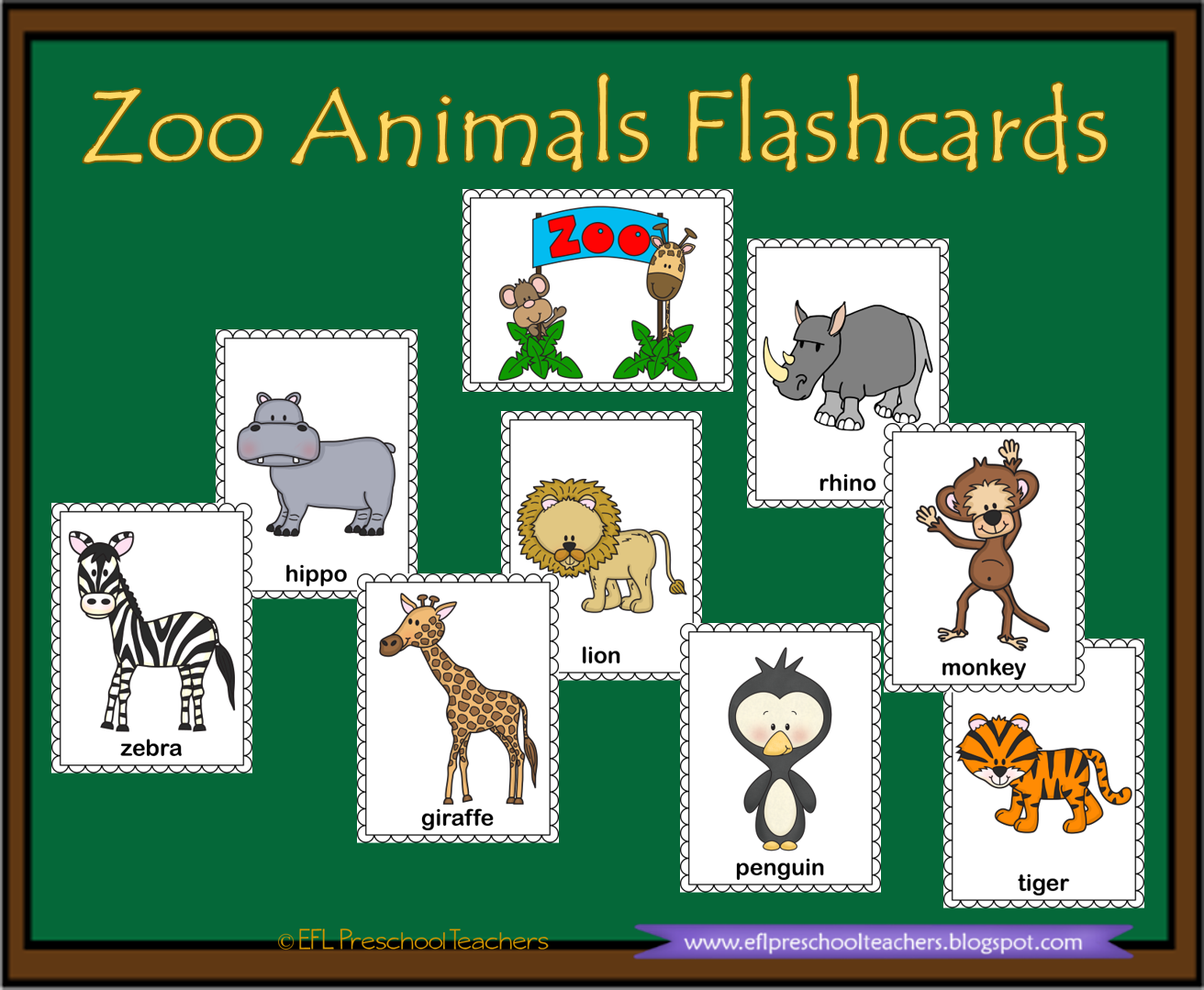
For the zoo or jungle animals you can find the kangaroo,giraffe, elephant, tiger,lion, crocodile,bear,hippo, monkey,toucan,snake, elephant, monkey flashcards among others.

Practice Zoo Animal Vocabulary and Sentence Patterns

Start with the zoo flashcards as a support material, place it in the middle of the classroom or board. Ask the students which animals they have seen or think lives in a zoo in their own language. As they come up with names, place them under the zoo flashcard and say the name in English.

Introduce this sentence for your students to model:
The hippo lives in at the zoo.

Teacher: What color is the hippo?
Students: It's gray!

zoo animals flashcards material

Use the zoo flashcards to reinforce the structure What is it?

Teacher: What is it?
Students: elephant! It’s an elephant.

Teach Zoo Animal Action Verbs

Use the flashcards to introduce how the animals actually move.

Teacher: How does the elephant move?
Students perform the action.
Teacher: Oh! Elephants walk.
Continue with the rest of animals using the flashcards. Introduce the verbs such as swing for the monkey,swim for the sea lion, walk for the elephant.

Make statements with can: The eagle can fly.

fZoo animals unit flashcards for kindergarten ESL students

Practice Listening Skills with Movement Commands

Place several animal flashcards around the classroom. It can be on board, under the chairs, on the desks, etc.
Teacher: Where is the lion?
Students: (run and touch) Here!

flashcards around the classroom

Move like the zoo animals do.

 These are commands review flashcards.

Students will understand and be able to give simple classroom commands.  Students should be related to the language used in the classroom. Here is an example with the giraffes. There are more zoo animals flashcards for students to identify how they move, such as: touch,eat, greet and more.
Use these flashcards to introduce the present continuous.
Teacher: What is the giraffe doing?
Students: It's writing.

Zoo animals commands  flashcards

Students will understand and follow spoken instructions. Describe the zoo animals movement. Show the Command flashcards one by one and say: Stand up like the bear!
Students will do the action, continue with the rest of the cards.

zoo animals movement

The zoo animals are performing an action that are shown on each flashcard.

Show the students another set of flashcards and ask questions: What is the tiger doing?
Students: It is writing! (Students perform the action)


school commands flashcards

Use the lions or any other movement or action verb flashcards to count the animals.
Teacher: Let’s count the lions.
Students: one, two, three, four, five! Five lions.

Lions zoo animals movement flashcards commands

Teach Zoo Animal Body Parts

Use the flashcards to help students identify the zoo animals body parts. Introduce the word tail. Place several zoo animals on the board but inside a plastic clear sheet. Hand in several whiteboard markers and give instructions to some students to circle the tail.

Teacher: Zoe, circle the tiger’s tail!
Mike, find the eagle’s tail and circle it.
Teacher: Whose tail is it?
Students: It’s the zebra’s.
Continue with long and short.
Teacher: Which animals have long tails?
Students: the lion! The giraffe!
Teacher: Jill, Cross their tails.
Do the same with short tails.

zoo animal body flashcards

Review the adjectives long, short, big and small with the  Zoo Animal

Keep working with the adjective long! Use neck and legs. Have the students find the animals with long necks and draw a rectangle. Then have them circle the long legs on each animal. Ask questions.
Teacher: What animals have two legs?
Students: the kangaroo, the flamingo and the monkey!
Teacher: What animals have four legs?
Students: the giraffe and the elephant!
Students can write the number next to each animal’s legs.

zoo animals adjective long

Repeat with the short legs animal flashcards. This activity can be done with arms, necks, feet and any other body part that you would like to contrast between long and short.

short legs animal flashcards

Sort the animals into big and small

 One of my favorite ways to use these Zoo Animals Flashcards is as a Big and Small sorting activity. Display the "big" and "small" category cards on the board and invite students to take turns placing each zoo animal in the correct group. This hands-on activity encourages children to observe, compare, and classify animals while practicing important English vocabulary.

Students can discuss their choices using simple sentences such as "The elephant is big," or "The monkey is small."

Sort the zoo animals into big and small

 zoo animal flashcard can work to identify the body parts

 Include as many words that you need: stripes,neck, ears, eyes, legs, tail,paw,beak,trunk,tail,wing.

identify the body parts for the zoo animals

        There is a set of Zoo Animal’s Faces to review the parts of the face.

Zoo Animal’s Faces

Students will associate what the ZOO animals eat

Use the flashcards to help associate the zoo animals to what they eat. Place the giraffe flashcard in the middle of the board. Ask students what does the giraffe eat. They might say words in their native language. Pull out the flashcard of the food items they have guessed and say the word in English.
Teacher: Giraffes eat leaves!

Zoo Animals eat

Teach Feelings and Emotions with Zoo Animals

Use these Zoo Animals Emotions Flashcards  as a hands-on sorting activity. Display the emotion categories—happy, sad, and angry—on the board and invite students to take turns placing each zoo animal in the correct group. As they manipulate the cards, they practice identifying facial expressions while building important English vocabulary.

This activity encourages meaningful speaking practice as students describe the emotions of the animals using simple sentences such as, "The lion is happy," or "The zebra is angry."

Teach Feelings and Emotions with Zoo Animals

Review  two-dimensional Shapes with Zoo Animal Activities

Display the four basic shapes—rectangle, circle, triangle, and square—on the board and invite students to sort the zoo animal flashcards into the correct categories. As they manipulate the cards, they strengthen shape recognition while reviewing zoo animal vocabulary in a fun and meaningful context.

This hands-on activity encourages students to observe and compare the characteristics of each shape while practicing simple English sentences such as, "The lion is a circle," or "The giraffe is a triangle."

Review  two-dimensional Shapes with Zoo Animal Activities